
One person can make a difference
Celebrate Kitsap 2026 Honorees
At Celebrate Kitsap 2026, we honored four people whose lives and work shaped Kitsap County and the Kitsap History Museum. Each had a different background and a different way of serving this community. Together, their stories remind us that one person can make a difference.
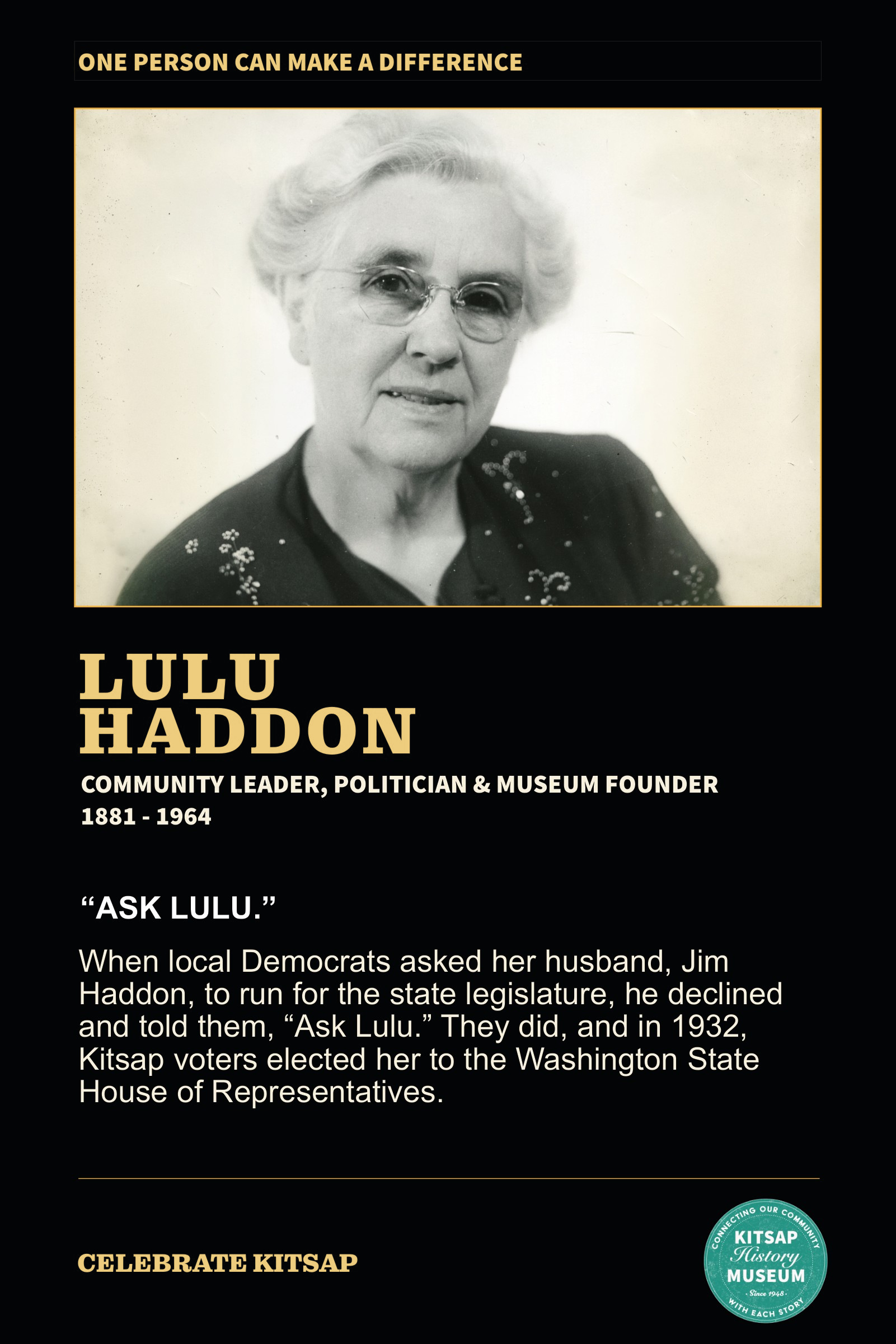
Select the poster to view it larger.
Lulu Haddon
Community leader, politician & museum founder
1881–1964
“Ask Lulu.”
Lulu Haddon was one of the people who helped start this museum. She grew up in a large Quaker family and received much of her education from her mother at home. She did not finish eighth grade. Yet she spent her adult life making education more accessible to others. She served on the Bremerton School Board for fourteen years, worked with the PTA and the library board, and became active in civic groups. When local Democrats approached her husband Jim about running for the legislature, he replied, “Ask Lulu.” And so they did! Kitsap voters elected her to the House in 1932, and she later served in the Senate.
Lulu came to Bremerton as a young woman, married Jim Haddon, and raised four children. The family ran Haddon’s Grocery west of downtown. The store put Lulu in daily contact with her neighbors. She understood their needs because she lived and worked among them. That practical connection to people carried into her public life. She championed schools, access to college, services for people with disabilities, and a toll-free Manette Bridge. She knew a community improves when someone pays attention to what people actually need.
Lulu served in Olympia during the Depression. Legislators received only five dollars a day, so she brought her own lunch each day. She chaired education committees in both houses and supported legislation for public junior colleges. Years of advocacy helped make Olympic College possible in Bremerton. Her daughter Frances Haddon Morgan later followed her into the legislature, winning Lulu’s former House seat in 1958 and Senate seat in 1960.
Lulu D. Haddon Elementary School was named in recognition of her commitment to Bremerton children and public education. The school no longer stands, but Haddon Park now occupies the former school site and continues to bear Lulu’s name. Her influence lives on in Olympic College and in the opportunities it has given generations of local students. For Lulu, education was a way to make room for other people’s futures.
Lulu was one of the people organizing the Kitsap County Historical Society in 1948. Just days after its first meeting, she joined Chloe Sutton, Eleanor Van Elton and A. P. Carroll before the county commissioners to request space for a museum. They secured a promise of room in the new county administration building in Port Orchard. The museum opened to the public there in two small second-floor rooms in May 1949. It was a modest start, but Lulu helped make the idea real. Someone had to ask, and Lulu was willing to do it.
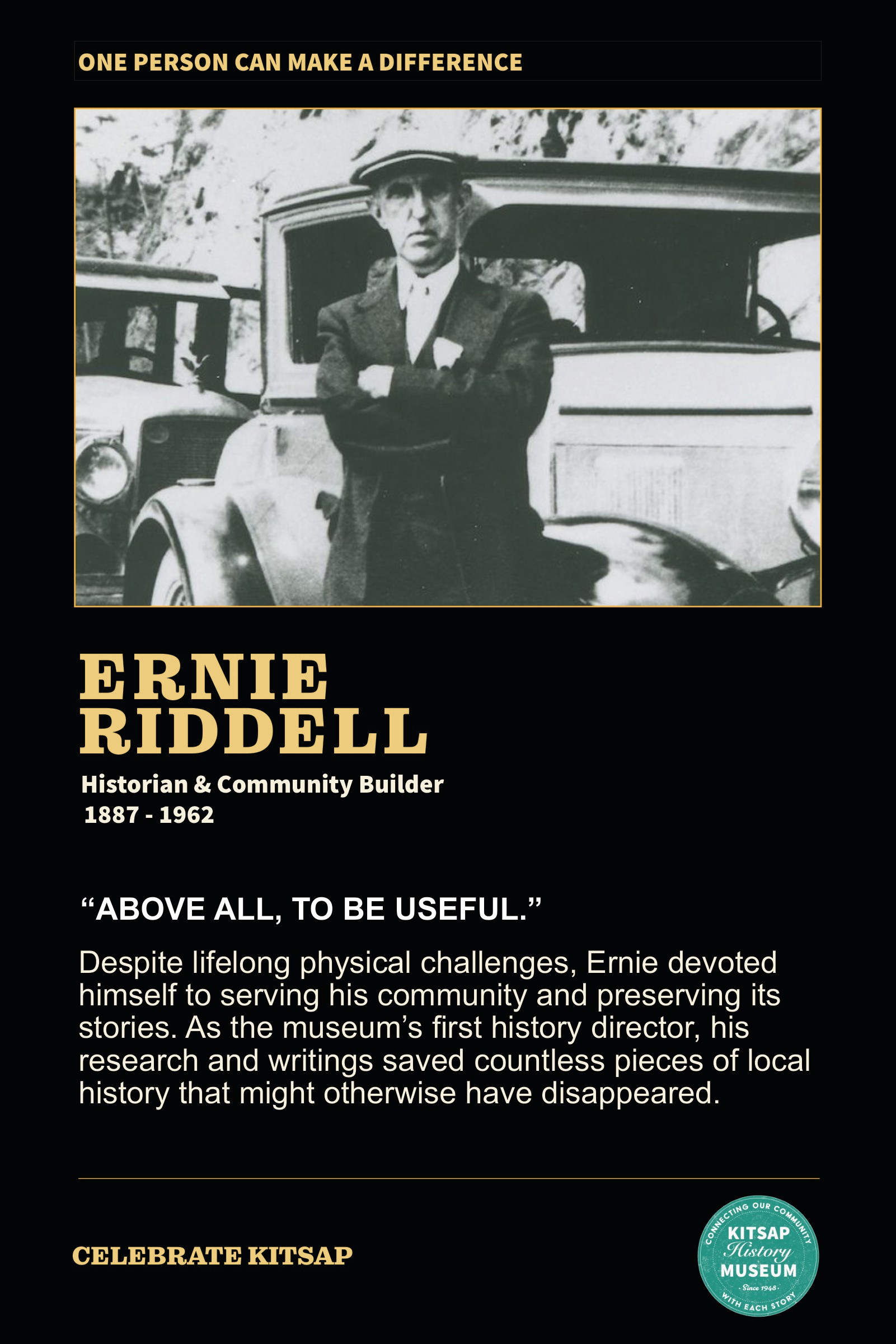
Select the poster to view it larger.
Ernie Riddell
Historian & community builder
1887–1962
“Above all, to be useful.”
Ernie Riddell grew up in Tracyton, where his father ran a store and became postmaster in 1898. Childhood illness and club feet made walking difficult, and he wore heavy braces. He nevertheless set out to get an education and to be useful to others. Years later, in his autobiography, he wrote that he wanted “above all, to be useful to my fellow beings.” That was more than a line of reflection. It described a life of service to his neighbors and a lasting gift to this museum.
Ernie wanted to attend Bremerton Union High School, but getting there from Tracyton was hard. For his first two school years he rowed along Port Washington Narrows, partly to avoid walking more than a mile from the Bremerton dock in his braces. The trip could mean dense fog or strong tides, but he said he was never late! From 1905 he took the steamboat and made that walk. He was one of Union High’s first three graduates in 1907. The determination it took to get to school also shaped the way he served his community for the rest of his life.
Ernie followed his father as Tracyton’s postmaster and served for more than forty years. The museum displays a surviving piece of that old Tracyton Post Office. He managed the store, delivered groceries, worked at the dock and organized people. At one point he was secretary of nine organizations, including the Kitsap County Good Roads Club. Given his work for better roads, it feels especially fitting that Tracyton’s Riddell Road carries the family name.
Ernie wrote about Tracyton, Poulsbo, Bangor, Seabeck, Hood Canal communities and many other places throughout Kitsap County. He recorded stories about early settlers, transportation, schools, post offices and everyday life. He also preserved firsthand memories of people whose stories might otherwise have vanished.
When local residents founded the historical society in 1948, Ernie became its first history director. He recorded community histories and firsthand memories that remain valuable to researchers today. He also served as the museum’s treasurer. In 1954, Lillie L. Abrahams presented him with a one-hundred-dollar check for the museum building fund. She had signed his 1907 high school diploma. Nearly fifty years later, both of them were helping build a place to preserve Kitsap’s history. Ernie’s papers and service still help us do that work.
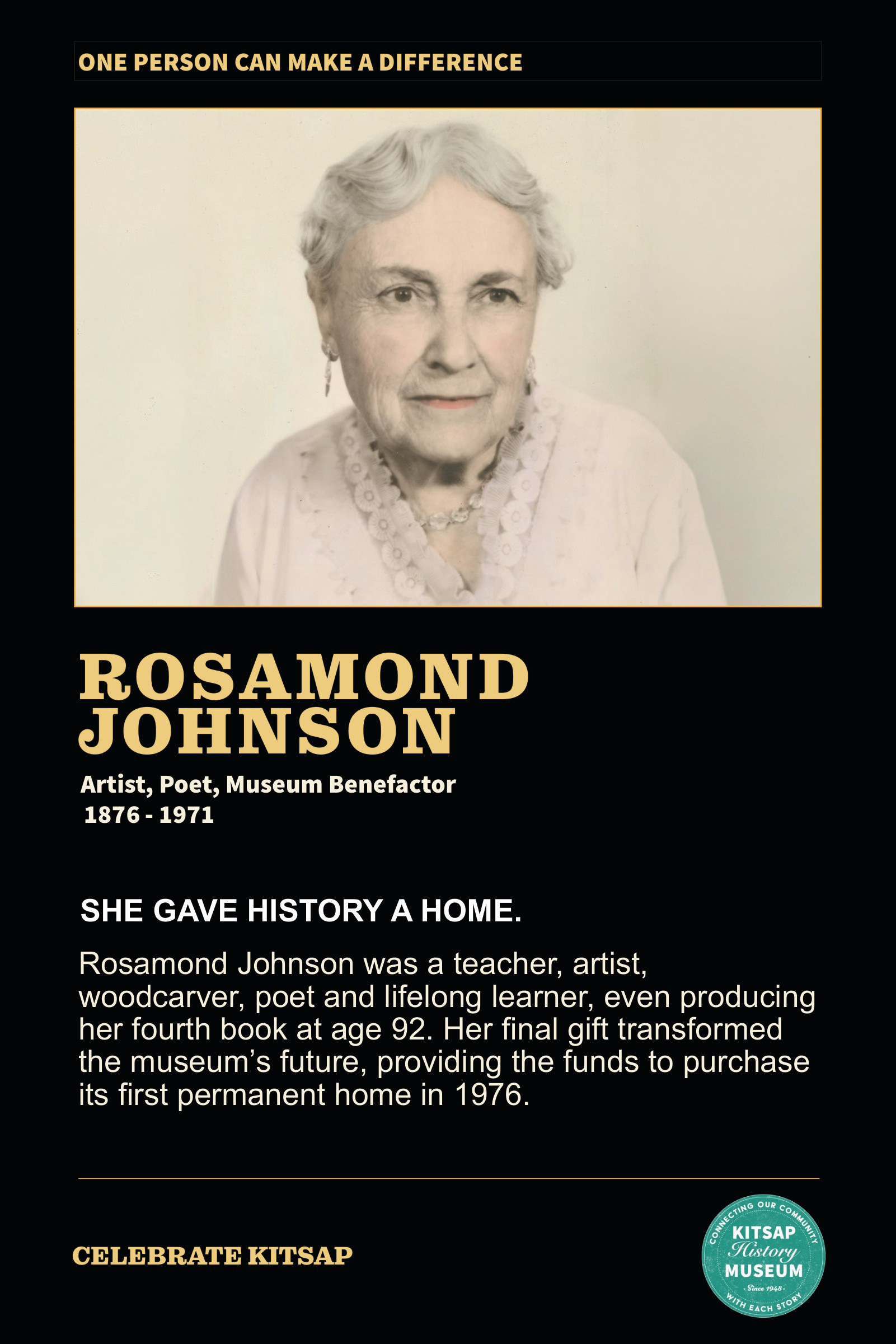
Select the poster to view it larger.
Rosamond Johnson
Artist, poet & museum benefactor
1876–1971
She gave history a home.
Rosamond Johnson was a teacher, artist, woodcarver and poet who made South Kitsap her home. She taught in one-room schools, made carved furniture and paintings, and wrote poetry rooted in the place where she lived. Rosamond kept learning and making throughout her life. Her extraordinary final gift gave the museum a home of its own.
At 92, Rosamond decided to produce her fourth book of poetry herself, so she enrolled in a graphic arts class at Olympic College, learned offset printing and prepared hundreds of copies. After an accident interrupted the final work, friends and her instructor helped bind the books around their dining tables. When the first finished copies reached Rosamond in a rest home, she insisted that her bed be raised so she could see them. “Higher! Higher!” she said. That curiosity and determination make her more than a name attached to a bequest.
Rosamond made beautifully carved furniture and smaller pieces, alongside paintings and books. Some of those works came to the museum after her death. The things she made allow visitors to meet her as a creative person, not simply as the museum’s benefactor. Her decision to leave them to the museum helped ensure that future generations could encounter what she made.
When Rosamond died in 1971, she left most of her estate to the museum. Her bequest made it possible to buy the old Silverdale State Bank building in 1976. After years in borrowed and temporary rooms, the museum finally had a building of its own. When we later outgrew that space, its sale helped purchase the former bank building in downtown Bremerton where the museum lives today. Although Rosamond never walked through the first museum building she made possible, every visitor who enters our doors still benefits from her decision.
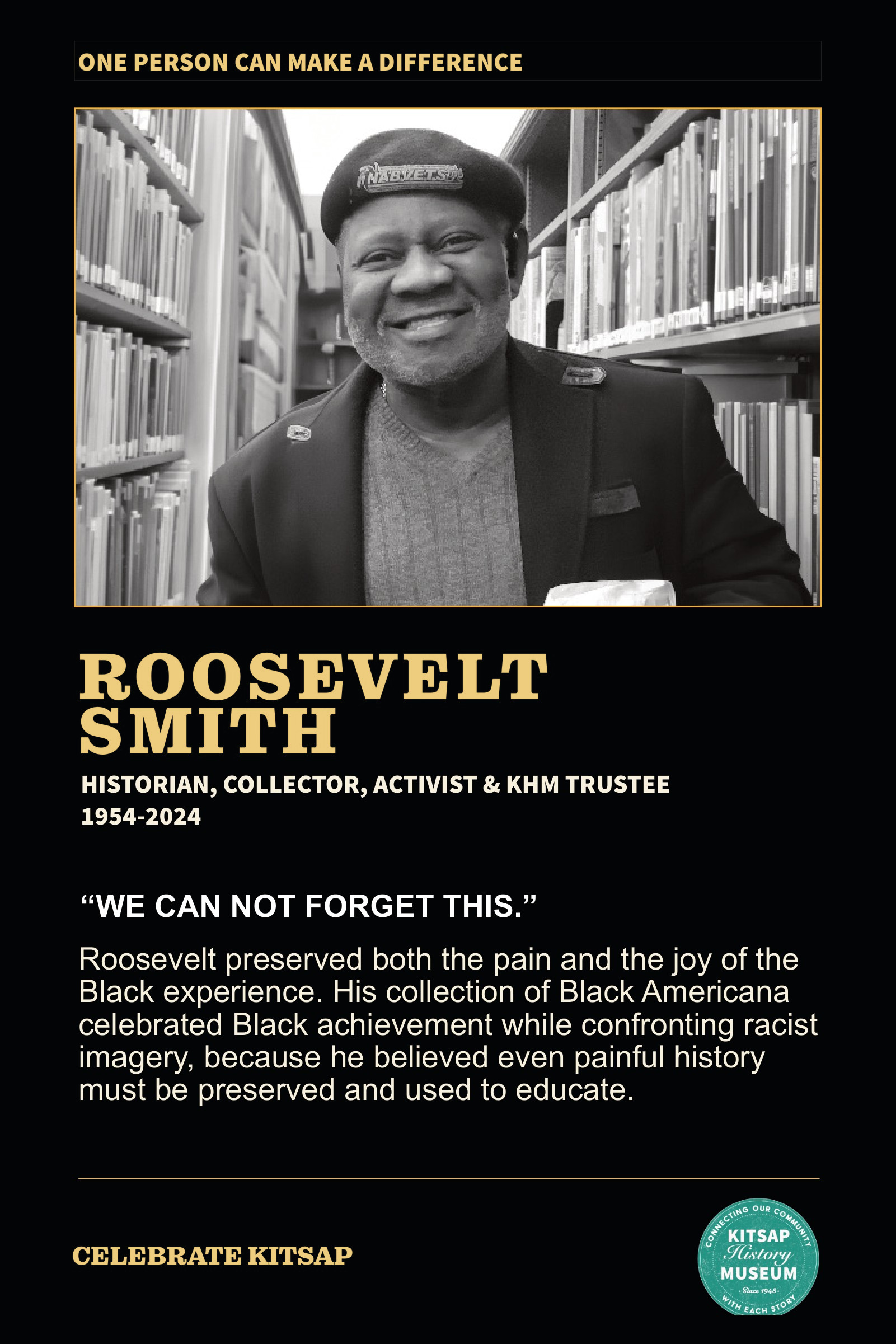
Select the poster to view it larger.
Roosevelt Smith
Historian, collector, activist & KHM trustee
1954–2024
“We can NOT forget this.”
Roosevelt Smith spent decades collecting Black Americana. His collection held books, photographs, art and everyday objects. Some celebrated Black achievement and joy; others carried racist images and stereotypes. Asked to describe the collection in two words, he answered, “Pain, joy.” He believed both were part of the historical record. The difficult objects could be painful to see, but hiding them would hide how racism was spread in ordinary life. Roosevelt wanted people to look, learn and talk. As he often said, “We can NOT forget this.”
Roosevelt lived in Kitsap County for more than forty years. A veteran, counselor, antique dealer and historian, he brought his collection into public conversation. He also researched local Black trailblazers and shared stories of people whose contributions had too often been left out. For Roosevelt, saving objects was only a beginning. Research and conversation could turn them into a public resource.
Roosevelt worked with the Kitsap History Museum to create the State of the Union in Black and White exhibit, which remained on view from 2020 to 2023. He did more than collect objects: he explained what they revealed, answered questions and helped people face painful history. Talking with children was one of his favorite parts of that work.
Roosevelt joined our Board of Trustees in 2021 and served until his death in 2024. He asked whose stories were missing from the museum and whether we would tell the difficult parts alongside the comfortable ones. That question still guides us today.
A legacy we carry forward
Lulu helped start the museum. Ernie saved local memories and gave his time to build it. Rosamond gave those stories a permanent home. Roosevelt asked us to tell a fuller story. Each used what they had to make something possible for the people who came after. Their work continues every time we preserve an object, share a story or welcome a visitor.